A colorful explosion of flowers reveals itself when you enter Córdoba’s hidden courtyards, which also hold a rich cultural history. Come visit some of the private courtyards and meet some of the residents.
Photo: Christian Grønne
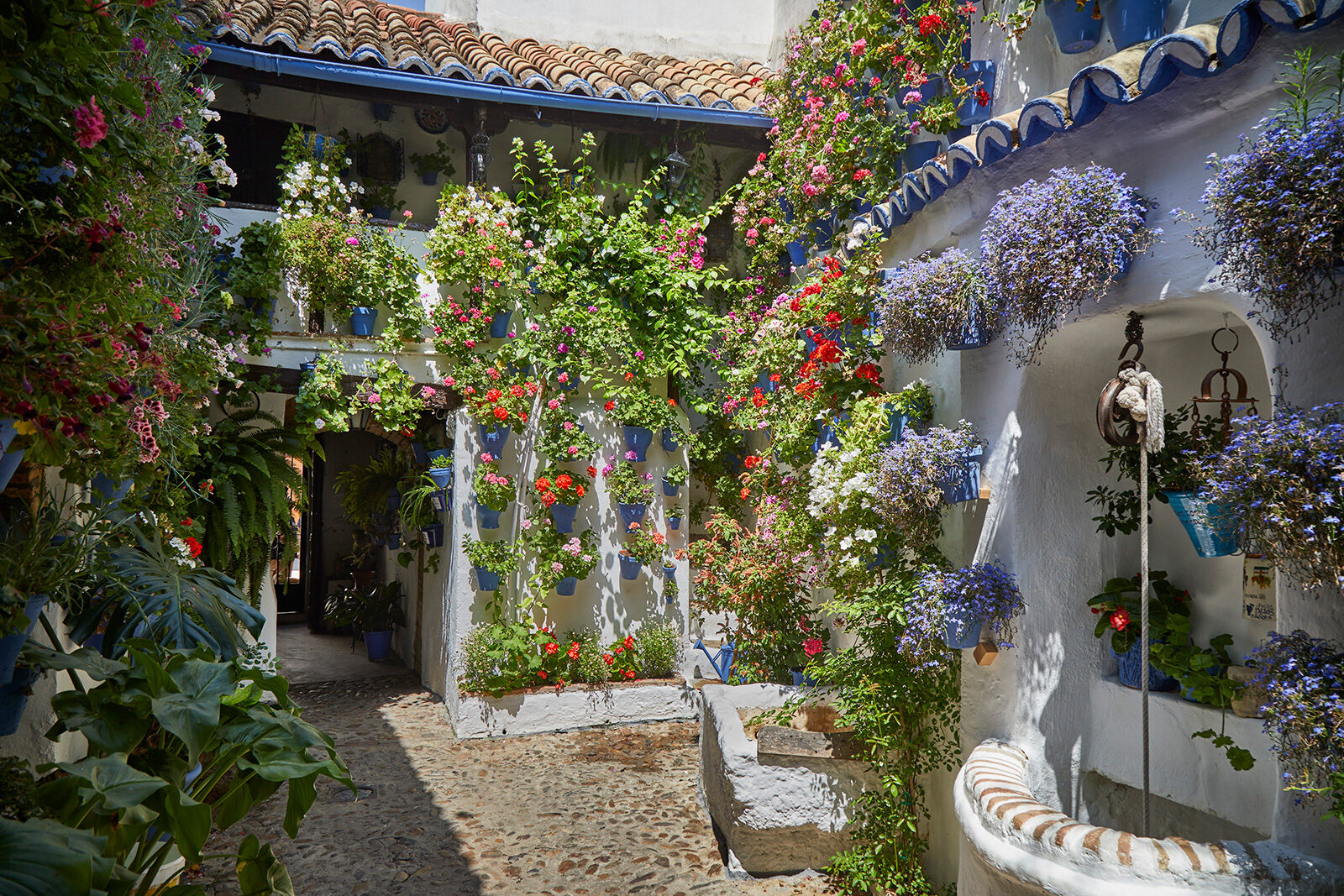
Cascades of colorful flowers in Córdoba’s typical blue flowerpots cascade down white house walls, large fruit trees, vines and exotic plants shade the sun.
Córdoba has over 4000 lush courtyards (patios) that have become a symbol of the city. The patios are attached to public buildings such as the mosque-cathedral, palaces and monasteries. However, a large part of them belong to private homes.
The shady courtyards are the residents’ oasis in the strong Andalusian sun. For generations, they have also been the center of daily family life. The surrounding homes have typically housed several families who cooked, ate, washed and ironed clothes and held family celebrations in the courtyards.
Every year in May, Córdoba hosts a patio festival (Fiesta de los Patios in Córdoba), which was inscribed on the UNESCO Intangible Cultural Heritage List in 2012. During the festival, around 40 patios open their doors to the public.
During the rest of the year, the gates to several of the courtyards are never completely closed. If you knock on the door, several will invite you inside. Most of them are located in the Alcazar-Viejo neighborhood.
My photographer and I visited the courtyards outside the festival period to see how they are laid out and to talk to some of the residents and owners.
 At the forefront of courtyard preservation
Our first stop is one of the most emblematic courtyards in Córdoba. It is located at 44 San Basillo Street in the Alcazar-Viejo neighborhood.
The courtyard is the center of a two-story building from the 14th-15th century. It is enveloped in fragrant flowers of all colors and surrounded by covered arcades. In the center is a well and a white staircase leads up to the first floor.
In a shady corner sits the owner of the property, Miguel Ángel Roldan Sánchez. He bought the property in the 1970s and until then, it was inhabited by 12 families, divided into 12 rooms, who shared a well and patio.
“Most courtyards have a well and a fountain. The courtyards have been here since Roman times, but it was the Moors who added flowers and plants in elaborate styles,” he says.
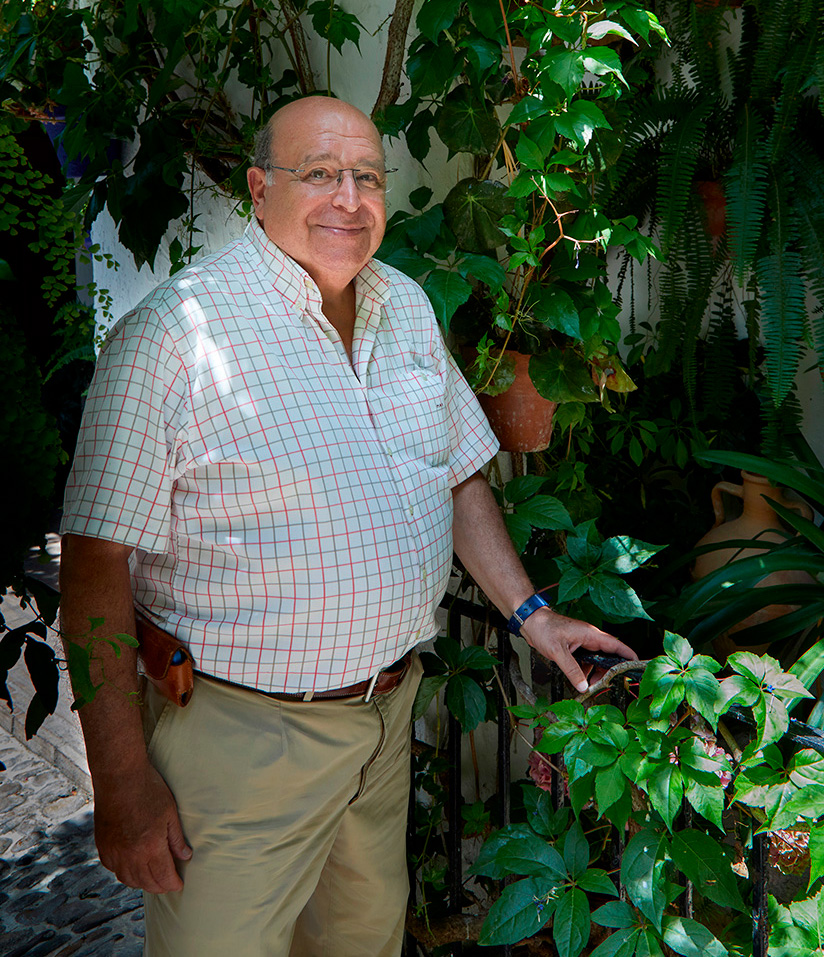 Miguel is the president of the patio association, Asociación de Amigos de los Patios de Córdoba. The association aims to preserve the tradition and passion for patios. It also organizes the annual patio festival.
The association originated in the 1960s, when many families in the neighborhood moved for more privacy and comfort, so the houses and courtyards were in great danger of being demolished.
Miguel says that many of the properties are passed down through the generations, and the design and life in the courtyards is carried on. However, families no longer live in his property.
“As you can see, several artisans have moved into the former ground floor apartments. They make classic handicrafts that Córdoba has been known for centuries. That’s why they fit in well with the historic setting of the courtyard,” says Miguel.
Miguel’s courtyard is also used by private families today. It can be rented for parties and many weddings are held here. The beautiful courtyard has also received several first prizes.
 Traditional Córdoba stones and remains of the city wall
On the edge of the Alcazar-Viejo neighborhood, on the street Martín de Roa 2, is an atypical patio owned by Araceli Valle López.
Araceli’s patio is shaped like a zigzag between the home and a large wall.
“It’s the remains of the 13th century Moorish city wall and we are the only ones in the city to have remains of the city wall in our courtyard,” she says proudly.
The floor is made of pebbles from the Guadalquivir River in a beautiful two-color mosaic pattern. It is a replica of ancient Cordoban floors, which are very popular in the city’s courtyards. The patio is adorned with 450 flowerpots with an abundance of plants and flowers both on the walls of the house and along the floor.
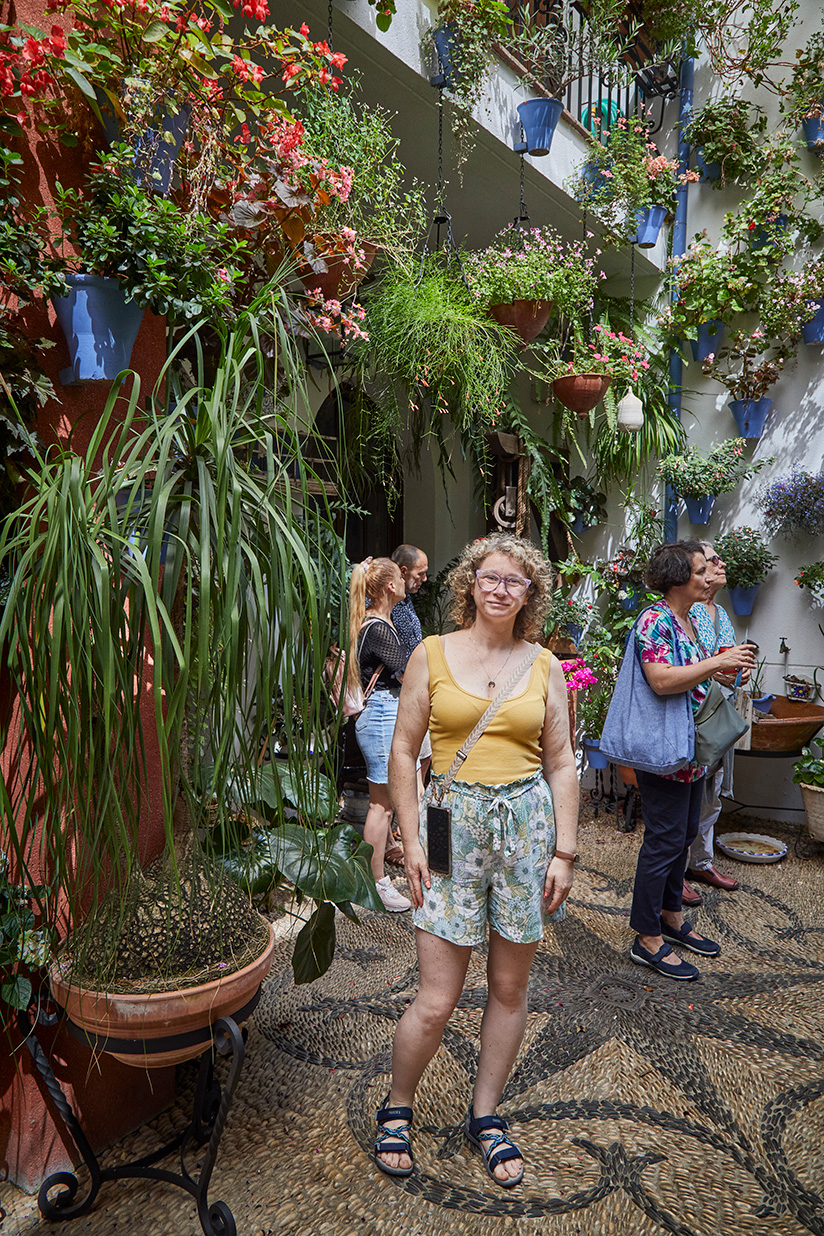
Araceli has lived on the property since 2003 with two family members. The courtyard was newly built in 2005 in connection with the renovation of the property.
“We built the courtyard in a traditional style and we have some furniture and ceramics that we inherited with the property,” she says.
The courtyard has several small cozy corners that the family, the house cat and visitors use daily. Araceli has around 70 different types of flowers. Including some tropical plants and a butterfly bush from the Philippines.
 Córdoba’s special water jug and archaeological finds
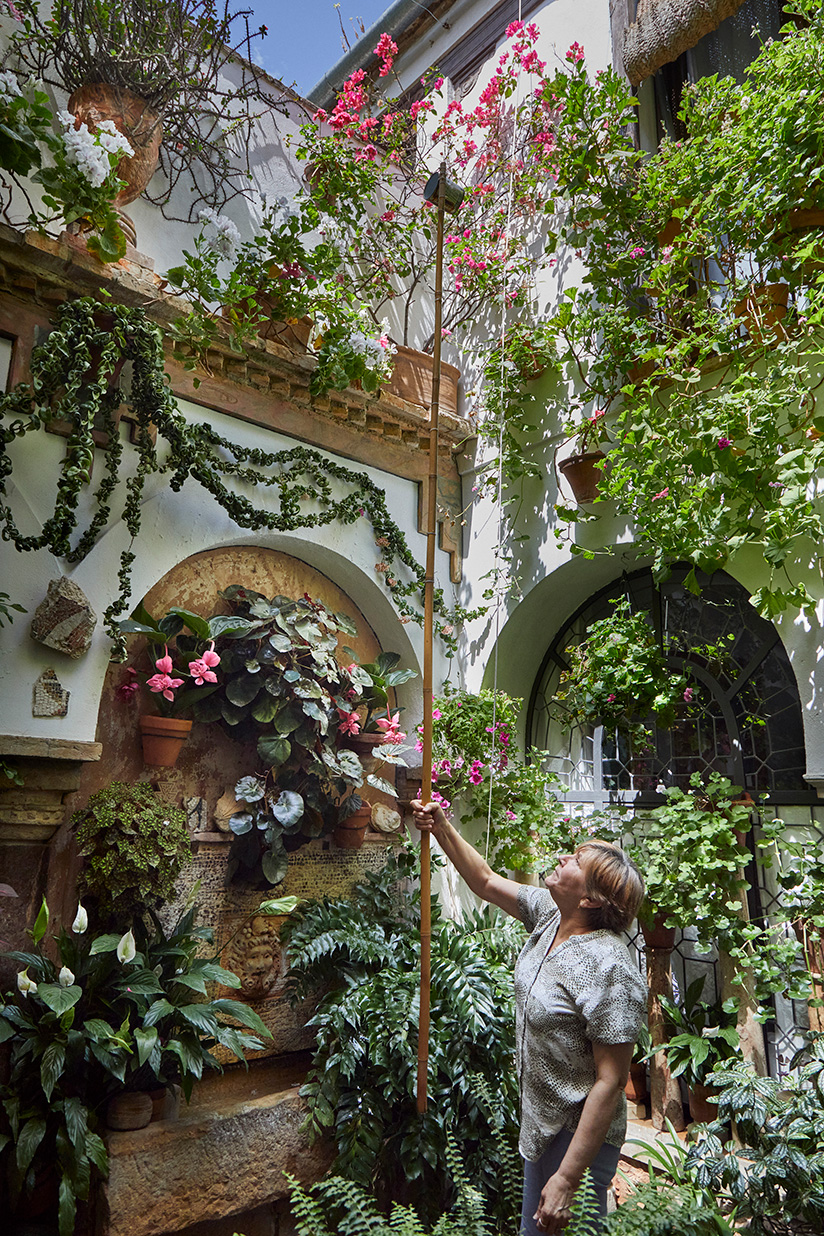
A woman is watering flowers with a strange watering can that consists of a nine meter long stick with a metal can at the end. We have entered the courtyard at 20 San Basilio Street. The woman with the watering can is Isabel Martínez and she owns the property with her partner Juan Jiménez.
“Many of the city’s potted plants hang high up, so a clever system had to be devised. The watering can is called la regadora or caña de regar and has been used for centuries,” says Isabel.
Isabel’s courtyard is surrounded by six arches and has an old drinking trough that collects water from a fountain for her to water. The courtyard belongs to an apartment complex, divided into two parts. It has relatively few flowers because there are some archaeological elements that also need space. Plants and flowers are therefore mostly used to frame them. This includes the remains of a Roman mosaic.
 The family maintains the patio together
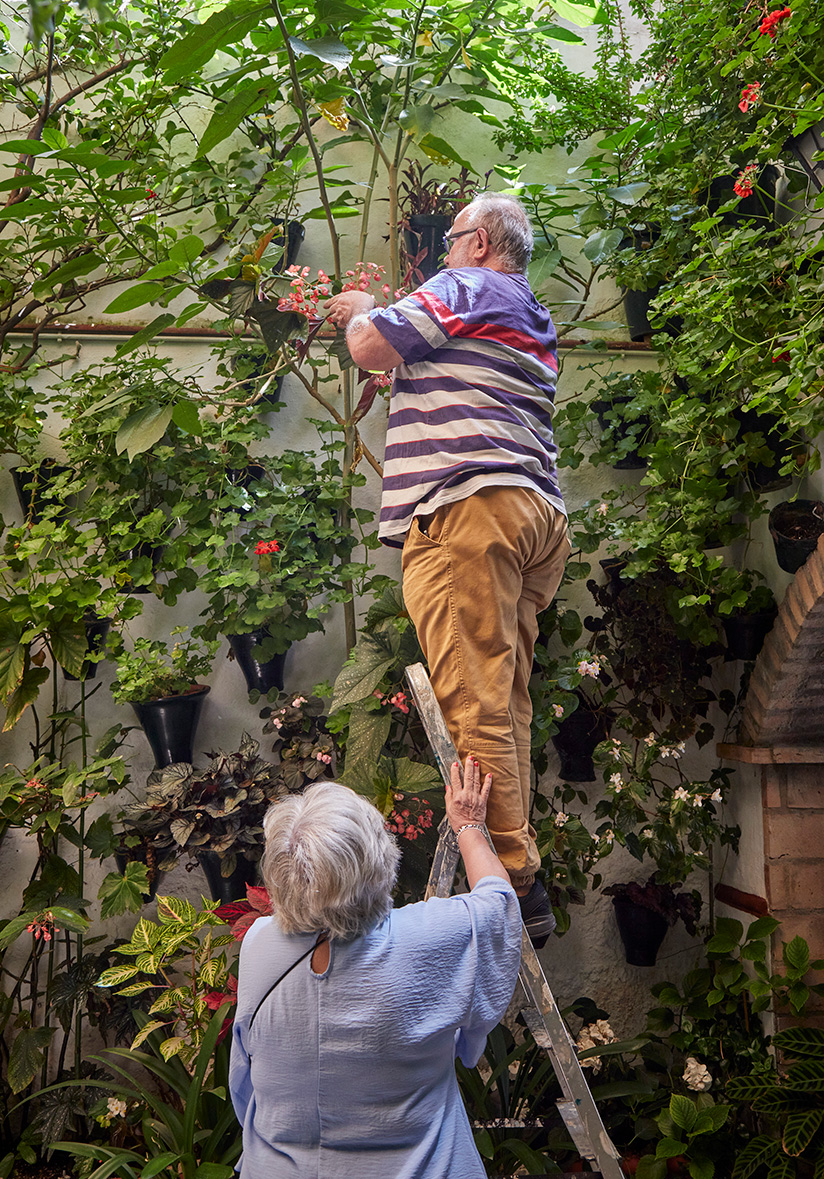
“It’s a lot of work looking after all the flowers and plants,” smiles Isabel Luque as we walk under the arch and into the patio at Calle Duartas number 2.
She holds a ladder where her brother, José Luis, is tying up a plant.
“I have over 400 different flowers and plants, including begonia, geranium and butterfly flowers. My patio is one of the patios with the most plants and it’s a lot of work to look after them,” she continues.
In addition to a wealth of fragrant flowers, the courtyard also has many fruit trees. There are also nice elements such as a narrow staircase leading up to a beautiful gallery. The courtyard belongs to a traditional apartment complex and has been renovated several times.
Isabel’s courtyard has won several awards during the courtyard festivals. Most recently in the “modern architecture” category in 2023, which includes courtyards renovated or built from the mid-20th century.
Jóse wants to show us his patio, which is right next door, so we continue there.
 Small hotel in beautiful blue corner
José’s patio hides at the end of the alleyway at 1 La Barrera, and it’s a beautiful and idyllic corner where blue tones dominate.
The patio dates back to the 17th century and José inherited it from his parents. He runs the small hotel Alojamiento de Patios in the property .
Guests can enjoy the small patio with its delicate color palette of flowers and green plants. Among them are an old dovecote, a water trough, rings and horseshoes , which are evidence that the patio was once a stable.
 Antiques tell family stories
In the courtyard at 14 San Basilio Street, there are no residents to spot, but we get a chance to sense the many atmospheres that have existed over time.
The courtyard is a treasure trove of antiques. It feels like traveling back in time in small glimpses, and I can easily imagine singing and dancing around the piano and sewing clothes for the family on the sewing machine. There are also Andalusian shawls embroidered and lace tablecloths for family celebrations.
The property dates back to the 16th century and many families have lived here together over the years. Today, the house is owned by Manuel Gaviño and his wife Lola. They have turned it into a small museum. You can peek into the former communal kitchen, with coffee grinder, pots and pans and fireproof dishes. There are also old bathrooms and a small room with old keys.
The patio also stands out from the crowd with its many red flower pots with flowers ranging from pink to deep pink and old clay pots.
 The artist’s creative oasis
The last stop on our tour is in the quiet San Pedro neighborhood where few tourists go. Behind a closed gate, I see a man pacing around a room at the back of the courtyard on La Palma street number 3.
I ask if we can come in and have a look, and he immediately opens the gate and invites us in for a coke. The man introduces himself as Manuel Cachinero, and he proudly and hospitably shows us around his patio, which is adorned with a large mandarin and lemon trees, hydrangeas, bougainvillea and wisteria.
Plants and trees shade the sun and Manuel waters the tiles every morning to keep the garden cool throughout the day.
“The courtyard is my paradise and the house and its history are very precious to me,” he says.
He jokingly reveals that he always dreamed of living in a stately house with columns, and his dream came true when he bought the house in the 1980s. The large property dates back to 1782 and Manuel lives here with his son and his family.
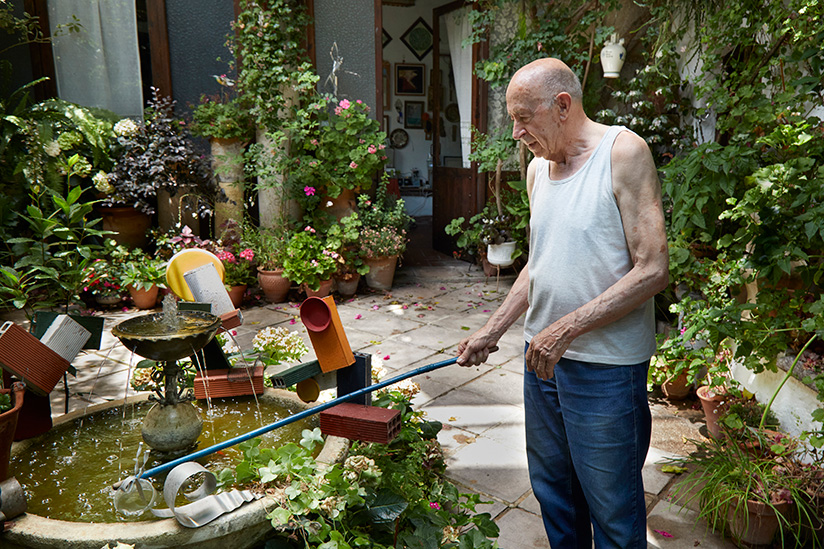
At the end of the courtyard is a fountain that is a faithful copy of an Arabic one from the time of the Moors. Both it and the trees have been there since the house was built. In the courtyard there are also historical elements such as an old gargoyle (water spout).
On the edge of the fountain, among plants, flowers and historical relics, we find several metal sculptures shaped like snails, Christ figures, bullfighters and dancers. They are made by Manuel, who works as a sculptor. He has a workshop in a small room at the end of the courtyard and was creating a sculpture when we disturbed him.
“I love to add my personal touch to the garden with my own works, and I hope that some of them will remain and become part of the history of the courtyard once I’m no longer here,” he says.
Manuel’s courtyard is full of personality and it’s my favorite. It’s not as well manicured as many other courtyards. It has also won several awards over the years.
 Courtyard sculptures in Córdoba’s squares
While you’re touring the courtyards of Córdoba, take a look at the three bronze sculptures created to symbolize the immense importance of the courtyards to the city. The works were created by local sculptor José Manuel Belmonte, and are located in various squares around the city.
The sculpture Grandfather and Child (Abuelo y Niño ) is located in Plaza de Manuel Garrido Moreno. It depicts an elderly man handing a potted plant to a child standing on a ladder.
The president of the Asociación de Amigos de los Patios de Córdoba, Miguel Ángel, and his grandson are the models for the sculpture. He says it symbolizes that the experienced and aging grandfather is passing on the traditions, culture and responsibility of caring for the patios to future generations.
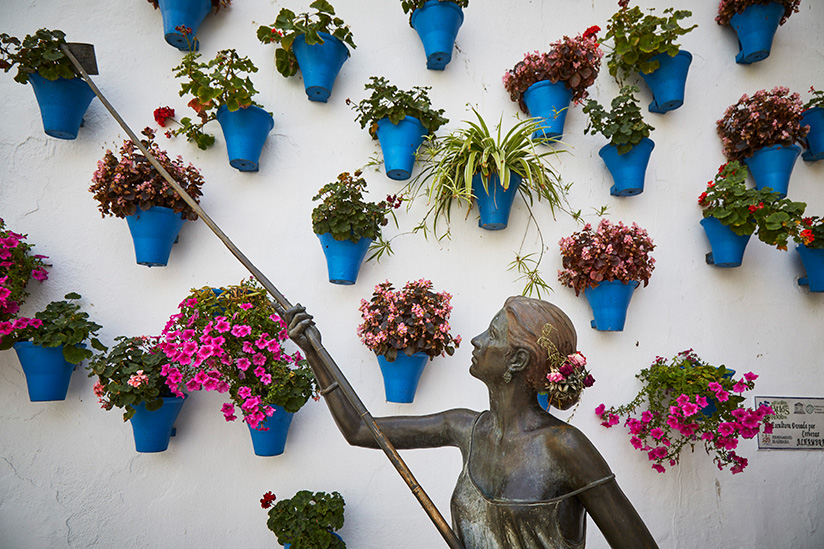 On In Puerta del Rincón Square stands the sculpture La Regadora (the watering can). You may have seen pictures of it on Instagram, as it is the most photographed sculpture in the city.
It depicts a young woman watering potted plants with a typical long Córdoba watering can used in courtyards. The stick is often made of bamboo and at the end is a metal can for the water.
The woman has a jasmine wreath in her hair and is wearing earrings and sandals, symbolizing Córdoba’s proud artisan traditions.
The last sculpture, The Well of Flowers (El Pozo de las Flores ) stands in Poeta Juan Bernier Square. It depicts a grandmother sitting in a chair with a potted plant in her lap. Next to her is a little girl clutching a flower to her chest as she watches her grandmother teach her how to care for the flowers in the gardens. Again, a sculpture about passing on traditions.
Behind the two figures is a well and in front of the girl is an empty chair. The chair invites visitors to sit down to be photographed in this symbolic tableau.
About the patio festival in Córdoba
- The patio festival, Festival de los Patios Cordobeses, is held every year in May and lasts for two weeks
- During the festival, you can visit many of Córdoba’s private courtyards and many of the public ones are open and specially decorated for the occasion
- The festival also includes concerts, activities and prizes for the most beautiful gardens.
- The Courtyard Festival has been held since 1921 and was added to the UNESCO Intangible Cultural Heritage List in 2012.
- There are different patio routes that you can follow. Some courtyards are open all year round
Check out the dates of the courtyard festival, find maps and read more.
More travel inspiration for Córdoba and Andalusia
For more inspiration for your vacation in Córdoba, check out the guide to the best things to do in Córdoba. In the guide you can read about the public courtyard Palacio Viana, among other things.
Read also the guide to restaurants and tapas bars in Córdoba. Read also the article about Córdoba’s spectacular mosque-cathedral. If you’re looking for accommodation, read which hotel in Córdoba I recommend.
If you want to visit the capital of Andalusia, find inspiration in the guide to Seville .